

These competitions will be contested in a role-playing simulation format.
Prior to each simulation, students will be assigned a country or personality to represent. Note that Elementary School Division students might compete together with Intermediate Division students if there are fewer than 10 Elementary School Division students signed up for a particular simulation.
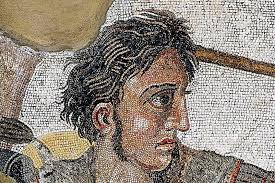 Alexander the Great died in 323 BC at just age 32 – but what if he had lived? He and his generals had been planning the invasion of Arabia at the time of his death; how might that have unfolded if Alexander had lived? Would his empire have held? Would he have shifted his focus to Carthage and a certain upstart city on the Italian Peninsula in the West? Or headed back to India to challenge the Nanda Empire? In this historical geography simulation, you’ll need to bring your knowledge of ancient geography to the strategy table as Alexander ponders his future moves. A full background guide will be provided in advance of the event selection period. This is a “crisis-committee” (meaning Alexander’s armies will act based on your directives, and you will need to deal with the positive and negative consequences as the war council progresses!).
While there is no limit to the number of potential students who can take part, if there are more than 28 students in a particular division, we will split into multiple rooms for a 1.5 hour preliminary session. The top students from that session would then be reassigned a different role and advance to a further 1-1.5 final session. The medals would then be solely determined by performance in the final session.
 After our successful simulation of OPEC at IGC 2024 (including a visit and private briefing at OPEC headquarters), we shift our attention to ASEAN, the leading regional multi-national organization for Southeast Asia, for IGC 2026. The topic for discussion at the 2026 ASEAN Summit will be: The Impending Independence of Bougainville. At this summit, that will take the form of a “crisis-committee” (meaning new information will be introduced during the committee sessions with which you will have to reckon), you’ll help chart the course of the future for Southeast Asia and its “near-abroad” of Melanesia. Papua New Guinea, which is an observer nation for ASEAN, is threatening to thwart Bougainville’s independence aspirations. Can the diplomats of the other 11 ASEAN nations bring peace to the region? What about the larger regional powers of the USA, India, China, Australia, as well as the neighboring Solomon Islands, who have also been invited to the summit? A full background guide will be provided in advance of the event selection period.
As there is a limit of 16 nations at the summit, if we have over 16 students in an age division, we will split into multiple rooms for a 1.5 hour preliminary session. The top students from that session would then be reassigned a different role and advance to a further 1-1.5 final session; the medals would then be determined by performance in the final session only. The final session may then take the topic in a somewhat different direction. If we have 16 students or less in an age division, then we will stay in the same session throughout, and the medals would be determined by the performance from start to finish.
M arriott is the world’s largest hotel company – and one of their properties is of course where IGC 2026 is taking place. Marriott has also been growing successfully for years across Asia, but how does the future look for growth and development in Asia for the American hotel giant? In this international business simulation, students will play the role of a Marriott executive who is responsible for a country or a specific aspect of Marriott’s business. The chair of the committee will take the role of Marriott CEO, Anthony Capuano, who is on a tour of Asia, and is eager to hear from his executives in the region in this ad hoc board meeting. Students should bring their knowledge of geography (especially Asia), their research on Marriott’s strategic plans, and their own negotiating skills to the boardroom for this simulation. A full preparation guide will be provided in advance. This is not a classic “crisis-committee” setting per se (as the premise is not that Marriott is not undergoing any sort of crisis), but certain new information will be introduced during the committee sessions with which you will have to reckon.
There is a limit of 24 board members in any one boardroom. If we have over 24 students in an age division, we will split into multiple rooms for a 1.5 hour preliminary session. The top students from that session would then be reassigned a different role and advance to a further 1-1.5 final session; the medals would then be determined by performance in the final session only. The final session may then take the topic in a somewhat different direction. If we have 24 students or less in an age division, then we will stay in the same session throughout, and the medals would be determined by the performance from start to finish.
 IAC is now running Model UN conferences in the USA, and IGC 2026 provides a perfect venue for us to continue expanding our Model UN offerings. This simulation will be a standard committee-style simulation of the UN General Assembly. The topic for the General Assembly committee, fitting for a simulation being held on the shores of the Andaman Sea, is Cooperation and Competition: The Geopolitics of the Indian Ocean. A full background guide will be provided in advance of the event selection period.
This committee will not be subdivided and will last a full 2.5-3 hours, but will be limited to no more than 40 students per age division on a first-come, first-served basis once Event Selection opens.
 IAC is now running Model UN conferences in the USA, and IGC 2026 provides a perfect venue for us to continue expanding our Model UN offerings. This simulation will be a crisis-style committee of the UN Security Council. Note that the topic will be different for each age division, and that the topic will only be announced at the start of the committee.
As the UN Security Council has only 15 members, if we have over 15 students in an age division, we will split into multiple rooms for a 1.5 hour preliminary session. The top students from that session would then be reassigned a different role and advance to a further 1-1.5 final session for which they would then receive a different country to represent; the medals would then be determined by performance in the final session only. The final session may then take the topic in a somewhat different direction. If we have 15 students or less in an age division, then we will stay in the same session throughout, and the medals would be determined by the performance from start to finish.
F lash forward to the year 2050 – and a very different world emerges. In just 24 years, at current projections, much of the developed world – and even many developing countries – will be undergoing significant population declines. Other nations, mostly in Africa, however, will continue to be growing at a rapid pace – if somewhat slower than in the early decades of the 21st century. What are the implications of these shifts for global health and geopolitics? What does this mean for climate change? For military strength? For food and resource allocations? Should nations take proactive steps to compel their citizens to have more (or fewer) children? This simulation will take the form of a World Health Organization session on the topic of Demographics & Population Change at the Midpoint of the 21st Century, but is not strictly limited to global health concerns – matters of geostrategy, international trade, and other topics are germane to this debate as well. This session will be a “standard committee” session – meaning that additional information will not be introduced during the session itself, though a background guide with hypothetical priors (this being a committee set 24 years in the future, after all) will be provided to set the terms for the debate.
This committee will not be subdivided and will last a full 2.5-3 hours, but will be limited to no more than 40 students per age division on a first-come, first-served basis once Event Selection opens.