

The competitions that are listed here will form the remaining medal events at the 2026 International Geography Championships in addition to buzzer-based quiz competitions, exams, hybrid buzzer and exam events, and simulations.
Following its debut at the 2024 International Environmental Science Olympiad, the Fieldwork competition makes its debut at IGC in 2026. This will be an optional competition for High School Division students only. Students will need to address one or more land use or geographically-themed problems in the area around Khao Lak. The competition will have on-site scouting, cartographic, analytical, and written components. Further details will be posted prior to the opening of Event Selection, though the specific task(s) that students will need to address will only be revealed at the beginning of the competition.
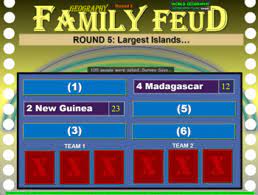 Geographeud returns to the IGC event line up for 2026 for all age divisions! This event sees two teams compete against each other in a competition reminiscent of the American game show Family Feud. In Geographeud, we ask teams to name one of the top five (or six, or seven, etc.) of a geographical category. For example “Excluding Brazil and Portugal, name the top five countries with the most Portuguese speakers.” Or, “Name the top six lakes by volume in the world.” Teams send up one of their players to buzz in on an initial guess – whoever gets the higher value controls the board (or can elect to pass). We then continue with the other team members, though once a team gets three strikes, the other team then can win the round by naming one of the remaining answers the first team missed. Of course if the first team gets all entries before getting three strikes, then they win. The twist is that teams get more points if they name one of the smallest values (e.g. the sixth highest lake by volume gets six points, while the highest lake by volume gets only one point). This rewards teams who can use their geography skills to make educated guesses – unless they know it outright!
Note that for 2026, as Geographeud is now an optional event, the teams for it will be determined once players have taken the Battery Exam. Teams will be made as even as possible; not on the basis of affiliation. Teams may consist of either 2, 3, or 4 players depending on how many people in each division sign up to compete. The number of players on each team will be as even as possible within a division, though teams with one less player are not at much of a disadvantage given the format, and teams with one less player may be on average slightly stronger to compensate for being shorthanded.
The Geographic Spelling Bee debuts as an official medal event for IGC 2026 for the Middle School, Intermediate, and Elementary School Divisions. It will consist of 60 place names from around the world, with 5 tiebreaker place names. No penalty is given if a term is spelled incorrectly; each correctly spelled term is worth one point.
While we will try to resolve ambiguity in advance, some terms may have several correct spellings. All spellings will conform to standard accepted British or North American English orthography at the sole discretion of IGC staff. Some knowledge of geography will no doubt be useful, in particular as each term will be defined or identified after the place name itself has been read out loud. Place names will be repeated thrice, and then all terms will be repeated in quick succession at the end.
G-O-O-D L-U-C-K!
 Many geographically savvy students have enjoyed the Geoguessr game since it debuted online in 2013. At IGC, participants play a modified version of it; the 2022 competition pictures and their answers are listed below. In 2026, the rules will be similar in this optional competition for all age divisions. Note that the images will likely be shown on a large screen in the room we are in, or if that is for whatever reason not possible, then on a laptop or monitor provided by our staff. There is no need for participants to bring their own computer or mobile phone.
International Geography Championships – Geoguessr Official Rules
Elementary Geoguessr Pictures
Middle School Geoguessr Pictures
High School Geoguessr Pictures
Answers – All Divisions
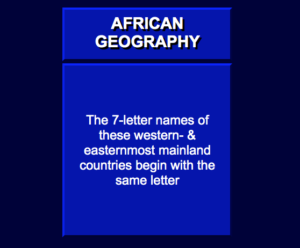 Geopardy, as its name suggests, is a game based on the popular quiz show Jeopardy! with a number of adjustments so that we can make it a competition event for IGC. Up to 5 students compete at a time, selecting clues of varying values and difficulty from a grid of categories (all of which, of course, will have geographic themes). Students will not be able to ring in until the moderator has finished reading each question. If a student answers correctly, they get the points, and pick the next question. Students will play one full game, with the top students in each age divisions making the semifinals, and then the top players in the semis will play in the finals.
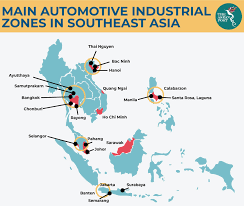 At each International Geography Championships and International History Olympiad, The Great Trading Game is one of the most eagerly anticipated optional competitions. At IGC 2026, Jay Wickliff, Great Trading Game inventor and IAC veteran staff member presents this year’s variant: The ASEAN Automobile Trading Game!
Note: For this competition alone, divisions may be subdivided into their component grades, with separate medals being awarded for, e.g., both 7th graders and 8th graders, rather than a Middle School Division as otherwise done throughout IGC. A decision on this point will be made at the end of the Event Selection period based on sign up numbers.
The Great Auto Trading Game is a fun and interactive experience often resembling the traditional trading floor of a stock exchange. It immerses players into the economies of four ASEAN countries with growing auto industries and the four dominant auto industry countries. The auto industry, like many modern industries, relies on a complex network of international supply chains. While China, Japan, Germany and the United States are home to eight of the ten largest car producers, Indonesia, the Philippines, Thailand and Vietnam have successfully built industries that play critical roles in these supply chains.
The game oversimplifies the countries’ economies in many ways. Moreover, the timeline is condensed, and the game focuses on a few commodities. Nevertheless, the game demonstrates the interdependence of the four developed economies and the emerging ASEAN economies. It will give players a sense of the challenges facing these countries. Players will deal with the twists and turns of the international economy and political framework, while exercising and expanding their diplomatic, tactical, and negotiating skills. Knowledge of ASEAN economies, strategy and a bit of luck will also play a role in determining the winner of The Great Auto Trading Game.
 Competition Type: Team, 6 different events
This is a required event for all competing students.
The Hextathlon (sometimes spelled Hexathlon; both versions are considered correct) is a collaborative team event where team members will work together to come up with correct answers on 6 different types of quizzes, including the following:
1. Crossword Puzzle Quiz
2. 3-2-1 Quiz
Teams will hear questions audibly and have the chance to submit an answer off a difficult clue for 3 points, a moderate clue for 2 points, or an easy clue for 1 point. Clues will be read in 3-2-1 order, with teams having an opportunity to submit an answer before the next clue is read. Teams can only submit 1 answer per question, however (i.e. you cannot submit an answer after each clue, or go back and change your answer upon hearing a later clue)
3. Multiple Choice Quiz
4. Map Quiz
5. Audio Quiz
6. Picture Quiz
There will be a limited amount of time for each version of the quiz (likely 12-15 minutes for each step), and each quiz will be worth the same amount in the overall score.
Knockout is a competition unique to the International Geography Championships, International History Olympiad, and the International Environmental Science Olympiad.* Up to 15 players sit or stand in a circle. One player begins, and then selects another player based on the category of the question – that player then has to answer a question correctly. If they don’t, they get a strike. If they answer correctly, then they get the chance to pick the next player. If you get a certain number of strikes, then you’re out! The top players move on to additional rounds. At the end of the rounds, the last players to get knocked out receive bronze and silver medals, and the sole survivor is the gold medalist. See the official rules and scoresheet for further details.
Knockout – Official Rules
Knockout – Official Scoresheet
* IGC trivia note – The idea for this event comes from Jeder Gegen Jeden (translation: Each Against Everyone) – a German language TV quiz show. If you’re interested in seeing an episode of Jeder Gegen Jeden, click here. Even if you don’t speak German, you can probably get the gist of the show – and if you listen carefully, you may even be able to figure out a few of the questions and answers.
Following its inclusion in the 2023 International History Olympiad program in Rome (when the race component was held in the Circus Maximus !) Running Combined makes its debut at IGC for 2026! Running Combined is a “brains and brawn” mash-up competition that features a 50 question multiple choice exam (the same exam is used for Swimming Combined as well), and then depending on how students do, they are placed incrementally closer to the finish line of a running race – which will be held on the beach on the last day of IGC. The exam itself is held on the evening of the first day, so there will be plenty of time to train in the hotel gym if competitors so choose!
IAC debuted a Question Writing Competition at the 2025 International History Olympiad, and will feature the same at IGC 2026. Students will be given a choice of specific answerlines on which they will need to write questions from their preexisting knowledge of topics in geography. No outside resources will be allowed. Full rules will be posted in advance of the Event Selection period. Note that as this event will occur at different times for different age divisions, the topics given to students in each age division will vary.
The JW Marriott Khao Lak Resort & Spa has the longest pool in Southeast Asia! We’ll make good use of a portion of it in the new Swimming Combined competition. This event features a 50 question multiple choice exam (the same exam is used for Running Combined as well), and then depending on how students do, they are placed incrementally closer to the finish line of a swimming race. Note that in order to minimize the risk of legs hitting heads in the pool, competitors will be required to swim the breaststroke, not freestyle. Walking or running on the pool bottom (the pool is shallow throughout) will lead to immediate disqualification; IGC staff will serve as race marshalls to make sure competitors swim by the rules.
 This event is for High School and Middle School Division Students Only
For the 2026 International Geography Championships, the Symposium offers students a chance to present their own research. At IGC 2026, this event is now being expanded to include the Middle School Division as well.
Prior to IGC, students will write a 2000-3500 word geographic-themed research paper (there is no specific focus that the paper will need to take) on a topic of their choice. The research paper must be entirely original, though it is permitted for students to submit a relevant paper that they have previously written as part of their academic studies in school or homeschooling (though not a paper submitted for consideration at a past IGC or International History Olympiad). Papers must be formatted to include proper footnotes and a bibliography and should include a wide variety of sources. Any evidence of plagiarism will lead to immediate disqualification.
Students’ papers will be due in late June 2026, and will then be read by IGC staff. The top students will then be subject to an oral defense of their research by their readers. From those, the top three students in both the High School and Middle School Divisions, as selected by the readers will be invited to a dinner with IGC staff members at one of the resort restaurants, continuing a tradition begun at IGC 2022.
Note: You are welcome to use whichever citation format you prefer, although you must cite sources. Footnotes are preferred over endnotes, if you are using footnotes. You are also welcome to use MLA format (whereby, you would just indicate the author’s name [and work if citing more than one source by the same author] in parentheses, followed by the relevant page number). For all papers, a bibliography must be included, and a wide variety of sources (especially primary sources and interviews) is encouraged.